Selecting the right solar mounting system for a commercial project requires evaluating the installation surface, structural loads, environmental conditions, and long-term maintenance requirements. Commercial rooftop installations, ground-mounted solar plants, and solar carports each require different mounting configurations. The most suitable solution is determined by the project site, roof or soil conditions, solar module specifications, and local engineering requirements.
For commercial and industrial solar projects, buyers should focus on five key factors: mounting location, structural load capacity, material selection, foundation design, and installation efficiency. A properly selected mounting structure must securely support the PV modules while remaining compatible with the existing building or ground conditions. Choosing a system based only on its initial price may result in additional installation work, structural modifications, or maintenance costs.
Identify the Installation Environment Before Selecting a Solar Mounting System
The installation environment is the first factor to determine because it directly affects the mounting configuration, attachment method, and foundation requirements. Commercial solar projects generally fall into three main categories: rooftop installations, ground-mounted systems, and solar carports.
Each application has different structural priorities:
- Commercial rooftops: Require compatibility with roof materials, structural capacity, waterproofing requirements, and available installation space.
- Ground-mounted solar plants: Require appropriate foundations, soil assessment, support spacing, and resistance to environmental loads.
- Solar carports: Must support PV modules while maintaining sufficient vehicle clearance, parking space, and suitable drainage arrangements.
Landpower Solar provides mounting solutions across these applications, including flat roof systems, pitched metal roof structures, aluminum and steel ground mounts, and solar carports. Identifying the installation environment first helps narrow down the appropriate product category before comparing individual configurations.

Commercial flat roof ballasted solar mounting structure
Choose the Appropriate Mounting Solution for Commercial Rooftops
Commercial rooftop mounting selection depends primarily on roof construction, load-bearing capacity, and attachment requirements. Flat roofs and metal roofs require different mounting approaches, so the roof structure should be inspected before selecting the hardware.
Flat roof mounting systems are commonly used on warehouses, factories, distribution centers, and other commercial buildings. Ballasted mounting systems use weighted components to resist movement and uplift without relying on conventional roof penetrations. This can be useful where minimizing roof penetrations is a project priority.
However, a non-penetrating system does not automatically mean that every roof is suitable for ballast installation. The additional dead load, wind uplift, sliding resistance, roof membrane condition, and structural capacity must all be evaluated. Where the roof cannot accommodate the required ballast weight, another attachment configuration may be necessary.
For example, Landpower's Flat Roof Ballasted Mounting V2 features a pre-assembled triangular support, anti-slip design, and mid and end clamps. Its published product specifications include a tilt angle of 5–60 degrees, an applicable building height of up to 20 m, and aluminum alloy Al6005-T5, stainless steel 304 (A2), and EPDM materials.

Triangular support, mid clamp, and end clamp components
For commercial metal roofs, the attachment method should match the actual roof profile and structural support. Trapezoidal metal roofs, corrugated sheets, and standing seam roofs do not necessarily use the same mounting hardware.
Standing seam roof mounting systems are particularly useful when a compatible clamp can secure the mounting structure to the roof seam without drilling through the roof sheet. The clamp must match the seam geometry and be verified for the relevant mechanical loads.
Landpower's Standing Seam Metal Roof U Clamp Mounting Systems use U-clamp roof attachments, mid clamps, and end clamps with A2 (304) fasteners. The published product information describes a non-penetrating attachment approach for compatible standing seam metal roofs.

Standing seam metal roof solar mounting connection
Evaluate Roof Load Capacity and Attachment Requirements
Roof load assessment is essential before installing a commercial rooftop solar mounting system. The building must safely accommodate the additional loads introduced by the PV modules, mounting hardware, ballast where applicable, and environmental forces.
The structural review should consider several load categories:
- Dead load: The permanent weight of solar modules, mounting components, and ballast.
- Wind load: Pressure and uplift forces acting on the panels and mounting structure.
- Snow load: Snow accumulation that increases the downward load on the roof and mounting assembly.
- Maintenance load: Additional loads associated with inspection and maintenance activities where applicable.
For ballasted systems, engineers must verify that the roof can support the additional weight and that the ballast arrangement provides adequate resistance against sliding and wind uplift. For mechanically attached systems, the roof attachment points and underlying structural members must be checked for pull-out, shear, and other applicable forces.
Roof waterproofing is another important consideration. Penetrating attachments require suitable sealing details, while non-penetrating systems still need to be checked for roof membrane compatibility, drainage paths, and potential movement.
A roof survey, structural drawings, and project-specific engineering calculations should be completed before finalizing the mounting configuration. Product-level wind and snow specifications should not replace verification of the actual building and installation conditions.
Select Ground Mounting Structures According to Site Conditions
Ground-mounted solar structures are suitable for commercial projects where sufficient land is available and rooftop installation is impractical or restricted. Their design depends on soil conditions, foundation requirements, module arrangement, environmental loads, and installation access.
The two important decisions are the structural material and foundation type. Aluminum and coated steel structures offer different mechanical and installation characteristics, while ground screws, concrete foundations, and driven piles require different site conditions and construction methods.
Aluminum ground mounting is often considered when relatively lightweight structural components and corrosion-resistant materials are required. Landpower's Aluminium Ground Mounting Portrait uses anodized aluminum components and stainless steel fasteners. Its published specifications identify Aluminum 6005-T5 and Stainless Steel A2 (304) as the main materials.
The product is designed for open-field installations and lists both ground screw and concrete foundation options. Its published tilt angle is 0–65 degrees, subject to project design.
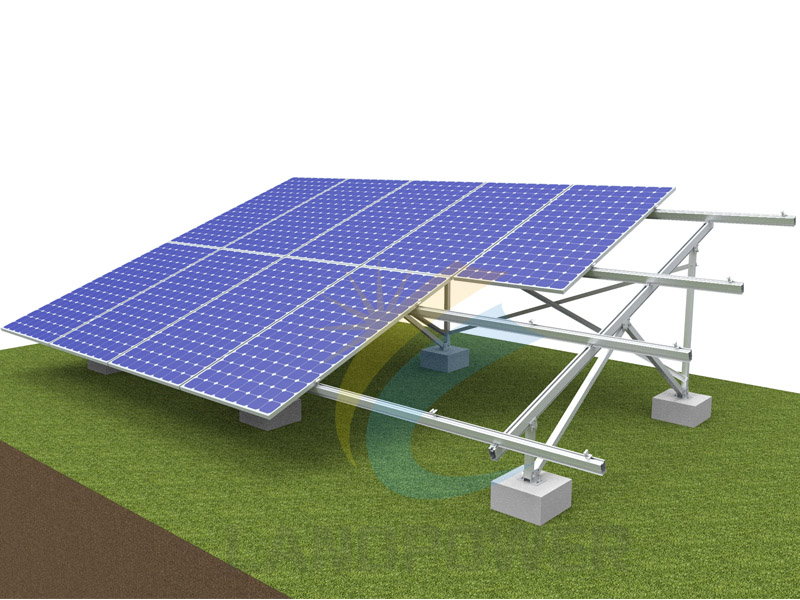
Aluminum ground mounting structure for commercial solar projects
Buyers can review Landpower's Aluminium Ground Mounting Portrait when comparing aluminum ground mounting options for larger PV installations.
Steel ground mounting may be considered where the project requires a different structural configuration or higher-strength support members. Landpower also lists galvanized steel and zinc-aluminum-magnesium coated steel ground mounting solutions.
The choice between aluminum and steel should consider member dimensions, structural calculations, corrosion protection, transportation, installation methods, and total project cost. It is not appropriate to compare materials only by weight or raw material price.
Foundation selection also deserves careful attention:
| Foundation Type | Main Characteristics | Important Checks |
|---|---|---|
| Ground Screw | Mechanical foundation installed into suitable soil. | Soil composition, pull-out resistance, lateral capacity, and corrosion protection. |
| Concrete Foundation | Concrete footings transfer structural loads into the ground. | Soil bearing capacity, footing dimensions, reinforcement, and curing requirements. |
| Driven Pile | Steel piles are driven into the ground to support the mounting structure. | Ground conditions, pile embedment, installation tolerances, and load resistance. |
The most suitable foundation should be determined through site investigation and engineering calculations. A foundation that works well in one soil condition may not provide adequate resistance in another location.
Consider Solar Carport Structures for Commercial Parking Areas
Solar carports are an alternative for commercial facilities with large parking areas. They combine photovoltaic generation with vehicle shelter, allowing parking space to serve an additional energy-related function.
Unlike conventional ground-mounted structures, solar carports must accommodate vehicle dimensions, traffic circulation, parking arrangements, and clearance requirements. Column positioning is particularly important because poorly positioned supports can reduce the usable parking area or interfere with vehicle movement.
When selecting a commercial solar carport, buyers should evaluate:
- Vehicle clearance and parking space dimensions.
- Single-column or other support arrangements.
- Steel or aluminum structural material.
- Panel orientation and roof configuration.
- Drainage and waterproofing requirements.
- Foundation design and site-specific wind loads.
Landpower's Steel Solar Carport Structure uses a single-column design intended to provide wider parking space and higher clearance. Its published product information specifies hot-dip galvanized steel for the main structure and SUS304 A2-70 fasteners.
The product page also lists the following technical references:
| Parameter | Published Product Specification |
|---|---|
| Maximum wind speed | Up to 60 m/s |
| Snow load | 1.4 kN/m² |
| Module orientation | Portrait or Landscape |
| Structure material | Hot-dip galvanized steel |
| Fastener material | SUS304 A2-70 |
| Foundation options | Concrete, ground screw, or ballasted concrete block |
Note: These values are published specifications for Landpower's steel solar carport product. They should not be interpreted as universal design limits or substitutes for project-specific structural calculations.
For commercial parking projects, buyers can explore Landpower's Steel Solar Carport Structure and discuss the required parking layout, support spacing, module dimensions, and foundation conditions.
Compare Structural Materials and Corrosion Protection
Material selection affects the structural performance, weight, corrosion resistance, and maintenance requirements of a commercial solar mounting system. The operating environment should be considered before choosing aluminum, galvanized steel, or zinc-aluminum-magnesium coated steel.
Aluminum alloy components are relatively lightweight and can provide corrosion resistance through appropriate surface treatments. Aluminum 6005-T5 is listed in Landpower's aluminum ground mounting specifications.
Galvanized steel is used in structural applications where steel members are required. The zinc coating provides protection against corrosion, although coating thickness, fabrication details, exposure conditions, and maintenance requirements should be reviewed.
Zinc-aluminum-magnesium coated steel is another option listed in Landpower's ground mounting product range. Its coating characteristics can be relevant when evaluating corrosion protection for outdoor mounting structures.
| Material | Potential Application | Selection Factors |
|---|---|---|
| Aluminum Alloy | Rails, brackets, and ground mounting components. | Weight, alloy grade, structural dimensions, and anodized surface protection. |
| Hot-dip Galvanized Steel | Ground mounting and solar carport structures. | Steel grade, coating quality, member dimensions, and environmental exposure. |
| ZAM-coated Steel | Steel ground mounting structures. | Base steel grade, coating specifications, connection details, and corrosion conditions. |
| Stainless Steel 304 | Fasteners and connection accessories. | Corrosion exposure, fastening compatibility, and contact with other metals. |
In coastal, industrial, or high-humidity environments, buyers should pay particular attention to corrosion protection. Dissimilar metal connections can also require appropriate isolation measures to reduce galvanic corrosion risks.
The best material is not necessarily the one with the lowest initial cost. Buyers should compare the complete mounting assembly, including fasteners, surface treatments, structural connections, and expected maintenance conditions.
Verify Wind and Snow Load Requirements
Wind and snow loads are among the most important engineering considerations for commercial solar mounting structures. The required design depends on the installation location, building height, terrain exposure, panel arrangement, tilt angle, and structural configuration.
Wind forces can create downward pressure, lateral loads, and uplift on PV modules and their supporting structures. Rooftop systems are particularly sensitive to roof-edge and corner wind effects, while elevated ground-mounted structures and carports require attention to overturning forces and foundation resistance.
Snow loading can also vary across the array. Panel inclination, module spacing, surrounding structures, and local snow conditions may affect how snow accumulates and transfers loads to the mounting system.
Before approving a mounting design, project engineers should verify:
- Local basic wind speed and applicable wind design standards.
- Terrain category, exposure, and building height.
- Ground snow load and applicable roof snow load.
- Panel tilt angle and array configuration.
- Connection strength, structural deflection, and foundation capacity.
Landpower's product pages publish different wind and snow specifications for specific mounting configurations. For example, the Flat Roof Ballasted Mounting V2 and Standing Seam Metal Roof U Clamp products each list maximum wind speed below 60 m/s and snow load below 1.4 kN/m². These figures apply to their respective published product specifications and must be checked against the actual project design.
A reliable mounting selection should be supported by structural calculations and applicable local codes rather than by comparing isolated maximum values from product brochures.
Evaluate Installation Efficiency and Long-Term Maintenance
Installation efficiency affects labor requirements, project scheduling, and overall construction costs. A mounting system with fewer components and suitable pre-assembled sections can simplify installation, but it must still meet structural and compatibility requirements.
When comparing commercial solar mounting products, buyers should review:
- Component count: Fewer individual parts may simplify storage and installation.
- Pre-assembly: Factory-assembled components can reduce certain on-site assembly operations.
- Connection methods: Standardized clamps and fasteners can simplify installation procedures.
- Transport requirements: Component dimensions and packaging should match the project's delivery arrangements.
- Maintenance access: The system should allow practical inspection of fasteners, structural connections, and drainage areas.
Long-term maintenance should also be considered during the selection process. Rooftop installations need access for module cleaning and structural inspections. Ground-mounted systems require attention to foundations, vegetation management, and exposed connections. Solar carports may require additional inspection of drainage and weather-exposed structural components.
A mounting system that is easy to install but difficult to inspect or maintain may increase the total cost of ownership. Buyers should therefore compare installation arrangements and maintenance requirements together.
How to Compare Commercial Solar Mounting Systems
A structured comparison helps EPC contractors, project developers, and distributors evaluate different mounting solutions using consistent criteria. Instead of focusing only on material price or installation speed, buyers should assess the complete system against the project's technical requirements.
| Evaluation Factor | Questions to Ask |
|---|---|
| Installation Compatibility | Does the system match the roof type, ground conditions, or parking layout? |
| Structural Performance | Can the structure withstand the required wind, snow, and dead loads? |
| Material Selection | Are the material grades and corrosion protection suitable for the environment? |
| Foundation or Attachment | Are the roof connections or ground foundations appropriate for the site? |
| Installation Efficiency | Are components pre-assembled, standardized, and practical to install? |
| Maintenance | Can the structure be inspected and maintained safely throughout operation? |
| Commercial Terms | Are lead time, MOQ, packaging, delivery, and project support clearly defined? |
For customized commercial projects, buyers should provide the mounting manufacturer with the project location, roof drawings or site layout, module datasheets, preferred installation configuration, and applicable structural design requirements.
These details allow the manufacturer to evaluate the appropriate mounting arrangement and clarify which technical specifications need to be confirmed before production.
Frequently Asked Questions About Commercial Solar Mounting Systems
1. What type of solar mounting system is best for commercial buildings?
The best system depends on the roof structure and installation conditions. Ballasted systems may suit compatible flat roofs, while standing seam clamps are designed for compatible standing seam metal roofs. Other metal roof profiles may require different attachments. Roof load capacity and structural compatibility should always be verified first.
2. What is the difference between ballasted and penetrating rooftop solar mounting?
Ballasted systems use weighted components to resist movement without conventional roof penetrations. Penetrating systems mechanically attach to the roof or underlying structure. Ballasted systems require sufficient roof load capacity, while penetrating systems require suitable attachment points and waterproofing details.
3. Should commercial solar projects use aluminum or steel mounting structures?
Aluminum is relatively lightweight and offers corrosion resistance, while steel is often considered for structural members requiring different strength and configuration characteristics. The choice depends on structural calculations, environmental exposure, material specifications, and overall project cost.
4. Which foundation is suitable for commercial ground-mounted solar systems?
Ground screws, concrete foundations, and driven piles are possible options depending on the mounting design and site conditions. Soil composition, bearing capacity, pull-out resistance, lateral loads, and installation equipment should be evaluated before choosing a foundation.
5. What wind and snow load specifications should buyers check?
Buyers should check the applicable local wind speed, snow load, building height, terrain exposure, module tilt, and structural configuration. Published product limits are useful references, but the final design must be verified through project-specific calculations and applicable building standards.
6. What information is needed to request a commercial solar mounting quotation?
Provide the project location, installation type, roof drawings or site layout, solar module dimensions and weight, required panel arrangement, wind and snow loads, foundation conditions, and estimated project quantity. Detailed information helps manufacturers evaluate compatibility and prepare a more accurate proposal.
Choose a Solar Mounting System That Matches Your Commercial Project
Selecting a suitable commercial solar mounting system requires a complete assessment of the installation environment, structural requirements, materials, foundations, and maintenance conditions. Flat roof projects need careful consideration of ballast weight and roof capacity, metal roof installations require compatible attachment methods, and ground-mounted systems depend heavily on soil and foundation conditions. Solar carports introduce additional requirements for vehicle clearance, parking layouts, and drainage.
The most effective selection process starts with accurate project information and ends with a mounting configuration supported by engineering calculations. Evaluating the complete system rather than individual components helps reduce compatibility issues and improve installation planning.
Landpower Solar offers mounting solutions for commercial rooftop, ground-mounted, and solar carport applications, including aluminum and steel structural configurations. Buyers can review the product range and discuss project-specific requirements with the company.
Planning a Commercial Solar Installation?
Contact Landpower Solar with your project drawings, module specifications, and installation requirements to discuss a suitable solar mounting solution.
Website: www.landpowersolar.com
Email: Sales@LandpowerSolar.com
Tel: +86-592-6212776
Location: Xiamen, China