Selecting an agricultural solar mounting structure requires more than choosing a support frame for photovoltaic panels. The structure must accommodate both solar energy generation and ongoing agricultural activities, including crop cultivation, irrigation, machinery access, and livestock movement. The right solution depends on crop sunlight requirements, panel height, structural materials, foundation conditions, and local environmental loads.
For farmland and solar greenhouse projects, buyers should prioritize five factors: sunlight availability, agricultural equipment clearance, mounting configuration, foundation suitability, and structural load capacity. These factors should be evaluated together before selecting an agricultural solar mounting system. A structure that supports solar panels effectively may still be unsuitable if it interferes with farming operations or creates excessive shading.
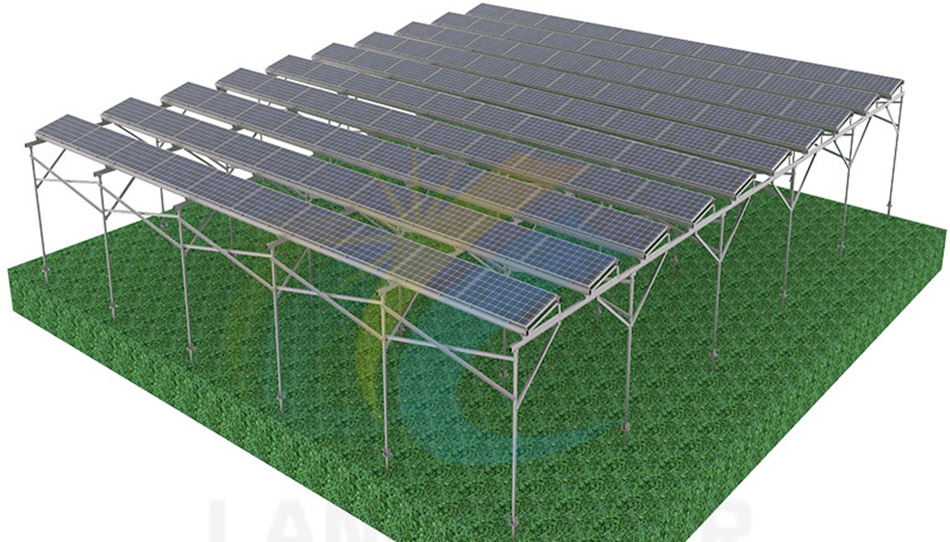
Agricultural farmland solar mounting structure
What Is an Agricultural Solar Mounting Structure?
An agricultural solar mounting structure is a photovoltaic support system designed for farmland, agricultural facilities, or greenhouse environments. Unlike conventional ground-mounted solar structures, it must consider the requirements of agricultural production alongside the mechanical requirements of PV installation.
This type of structure is commonly associated with agrivoltaic applications, where solar panels and agricultural activities share the same land. Depending on the project design, panels may be installed above crop-growing areas while maintaining space for sunlight penetration, irrigation equipment, and agricultural machinery.
A typical agricultural solar mounting system may include:
- Support columns: Transfer structural loads from the solar array to the foundation.
- Main beams and mounting rails: Support solar modules and distribute loads across the structure.
- Bracing components: Improve structural stability and resist lateral forces.
- Module clamps: Secure framed or compatible frameless PV modules.
- Foundation systems: Connect the support structure to the ground through suitable anchoring methods.
Landpower Solar's Agriculture Farmland Solar Panel Mounting is specifically presented for solar greenhouse and farmland applications. Its published product information highlights sufficient spacing for sunlight penetration and the movement of machinery and animals.
Evaluate Crop Sunlight Requirements Before Choosing Panel Height
The first consideration in agricultural solar mounting selection is how the panel arrangement affects the light available to crops. Solar modules inevitably create shade, but the extent and distribution of shading depend on panel height, tilt angle, row spacing, orientation, and the movement of the sun.
Different crops have different light requirements. Leafy vegetables, fruit crops, greenhouse plants, and shade-tolerant crops may respond differently to reduced sunlight. Therefore, there is no single panel height or spacing arrangement suitable for every agricultural project.
Before finalizing the mounting structure, project developers should evaluate:
- Crop species and their daily light requirements.
- Seasonal sunlight availability and solar radiation patterns.
- Panel row spacing and the distribution of shadows throughout the day.
- Panel height and its influence on light reaching the growing area.
- Future changes in crop rotation or agricultural practices.
For example, a project growing crops with relatively high sunlight requirements may need a different panel density and spacing arrangement from one involving shade-tolerant crops. The final design should be supported by agricultural assessment and solar shading analysis rather than relying only on the physical dimensions of the mounting structure.
A useful approach is to assess crop requirements and PV layout together during the preliminary design stage. This helps avoid situations where the solar installation performs well electrically but creates unacceptable conditions for agricultural production.
Determine the Required Clearance for Agricultural Machinery
Mounting height should be determined by the equipment and activities that need to operate beneath the solar array. Tractors, sprayers, harvesters, irrigation equipment, and livestock access may require different clearance dimensions.
A structure that is too low can restrict machinery movement and make routine farm operations difficult. Increasing the height, however, also changes the structural design requirements because taller support columns may experience different bending moments and lateral forces.
When defining agricultural solar mounting height, consider:
| Design Factor | What to Check |
|---|---|
| Equipment height | Maximum operating height of tractors, harvesters, and other machinery. |
| Operating clearance | Additional space needed for safe equipment movement and operation. |
| Support column positions | Whether columns interfere with field access, turning areas, or planting rows. |
| Irrigation layout | Space required for pipes, sprinklers, and maintenance access. |
| Maintenance access | Safe access for panel cleaning, inspection, and structural maintenance. |
For example, if a farm uses machinery with a maximum operating height of 3.2 m, the mounting design must provide additional clearance rather than setting the structure at exactly 3.2 m. The required allowance should account for equipment movement, uneven ground, and operational conditions.
Landpower's agricultural mounting product specifies a customized structure height. This allows project requirements to be discussed according to the actual farmland layout and equipment clearance needs. The final height and support arrangement should be confirmed through project-specific structural calculations.
Select the Appropriate Panel Arrangement and Tilt Angle
Panel orientation and tilt angle influence solar exposure, structural loading, land utilization, and shading distribution. The appropriate arrangement depends on the solar module dimensions, site latitude, crop layout, and the required agricultural working space.
Two common module arrangements are:
- Portrait arrangement: Modules are installed with their longer dimension generally oriented vertically. This configuration changes the overall array geometry and support layout.
- Landscape arrangement: Modules are installed with their longer dimension generally oriented horizontally. This affects rail positioning, support spacing, and the overall structural configuration.
Neither arrangement is automatically better for every agricultural project. Buyers should compare the module dimensions, mounting points, panel row layout, and structural span before making a decision.
Tilt angle also requires careful evaluation. A steeper angle may change seasonal energy production and increase the projected wind area of the panel array. A flatter arrangement may influence drainage, soiling, and sunlight distribution.
Landpower's agricultural farmland mounting product lists portrait and landscape module arrangements and a published tilt-angle range of 0–65 degrees, with design subject to project requirements. This is the product's stated configuration range, not a recommendation that every agricultural project should use the full range.
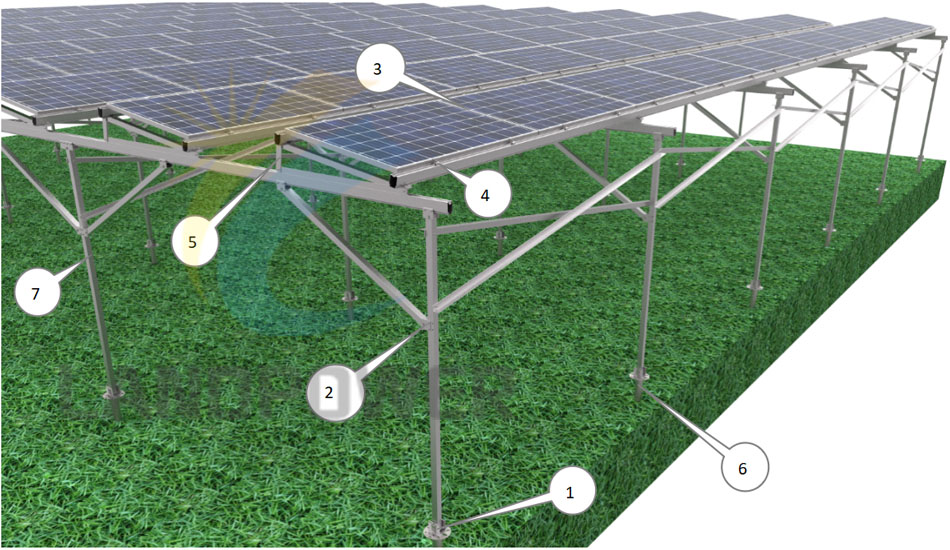
Agricultural solar mounting structure and support arrangement
For projects with specific panel dimensions or non-standard layouts, buyers should provide the module datasheet and installation requirements to the mounting manufacturer. This helps determine suitable rail spacing, clamp dimensions, support positions, and connection details.
Compare Aluminum and Steel for Agricultural Solar Structures
Aluminum and steel are both used in photovoltaic mounting systems, but their mechanical properties, weight, corrosion protection, and structural applications differ. Material selection should be based on the structural design, environmental exposure, and project budget rather than price or material strength alone.
Aluminum alloy is commonly used for mounting rails, brackets, and other structural components. Aluminum 6005-T5 is listed in Landpower's agricultural mounting product specifications. Its relatively low weight and corrosion resistance make it a practical material for many outdoor mounting applications.
Anodized aluminum can provide additional surface protection. However, the structural design must still account for member dimensions, connection details, deflection, and applicable wind and snow loads.
Coated steel is frequently used for support posts and larger structural members where higher structural strength and load-bearing requirements are important. Different protective coatings, including zinc-aluminum-magnesium (ZAM), are available for outdoor applications.
Landpower also offers a Single Row ZAM Ground Mount made from ZAM-coated S350GD high-strength steel. This is a conventional ground-mount product that can serve as a reference when evaluating steel structural solutions, but it should not automatically be treated as an agricultural mounting design.
| Material | Typical Applications | Selection Considerations |
|---|---|---|
| Aluminum 6005-T5 | Rails, brackets, and agricultural mounting components. | Weight, mechanical properties, corrosion resistance, and connection design. |
| Stainless Steel 304 | Fasteners and connecting components. | Corrosion exposure, fastening compatibility, and material grade. |
| ZAM-coated S350GD Steel | Ground-mounted steel support structures. | Structural strength, coating specifications, and environmental exposure. |
For agricultural environments with irrigation water, fertilizers, or high humidity, corrosion protection deserves particular attention. Buyers should evaluate the entire assembly, including fasteners, connections, surface treatments, and potential contact between dissimilar metals.
For a closer look at aluminum ground mounting configurations, explore Landpower's Aluminium Ground Mounting Portrait. For steel alternatives, the Single Row ZAM Ground Mount provides a reference for coated-steel ground mounting construction.
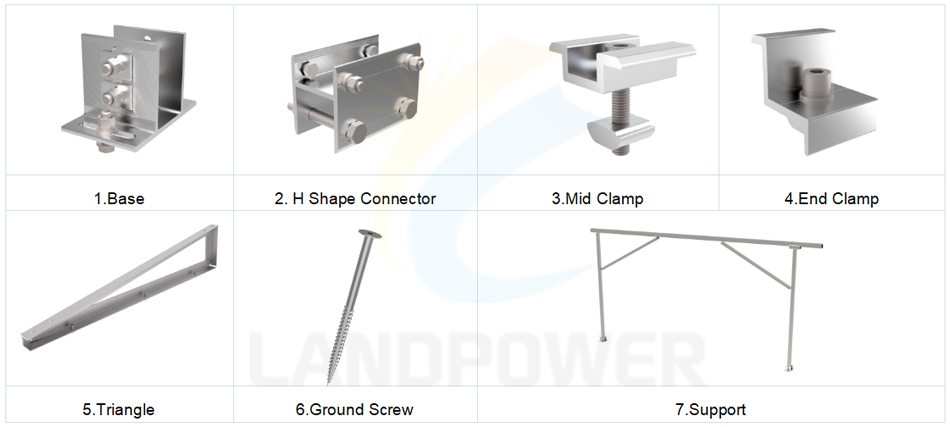
Solar mounting structural components and connection accessories
Choose Between Ground Screws and Concrete Foundations
Foundation selection should be based on soil conditions, structural loads, installation access, and long-term stability. Agricultural projects often have different ground conditions from conventional solar plants, so a foundation solution should never be selected solely because it is easier to install.
Ground screw foundations are installed by driving or screwing steel foundation elements into the ground. They may be considered where soil conditions and required pull-out and lateral resistance are suitable. Their installation can reduce the need for extensive concrete work, but actual feasibility depends on soil investigation and foundation calculations.
Concrete foundations use concrete bases or footings to transfer structural loads into the ground. They may be appropriate where project conditions require a different anchoring arrangement or where ground screw installation is unsuitable.
| Comparison Factor | Ground Screw | Concrete Foundation |
|---|---|---|
| Installation | Mechanical installation into suitable soil. | Requires concrete placement and curing. |
| Soil requirements | Depends on soil strength, composition, and installation conditions. | Depends on bearing capacity, footing dimensions, and foundation design. |
| Construction work | Can reduce concrete-related site work. | Requires excavation, reinforcement where designed, and concrete work. |
| Key verification | Pull-out capacity, lateral resistance, and corrosion protection. | Bearing capacity, footing dimensions, reinforcement, and curing. |
Landpower's agricultural mounting product lists both ground screw and concrete foundations as available options. The final choice should be confirmed after reviewing geotechnical information and structural calculations.
Another important consideration is the impact of foundation installation on agricultural land. Construction access, excavation, soil disturbance, drainage, and future cultivation should be reviewed during project planning.
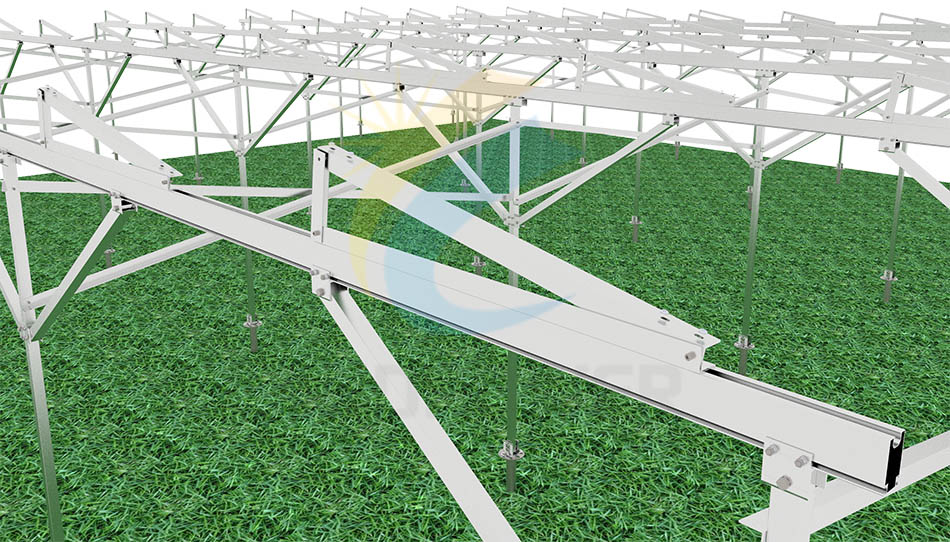
Mounting rails, brackets, and structural connections
Check Wind Loads, Snow Loads, and Structural Stability
Agricultural solar mounting structures must be designed for the environmental conditions at the installation site. Wind pressure, snow accumulation, temperature changes, and other applicable loads influence the required member sizes, connection details, support spacing, and foundation capacity.
Wind load is particularly important for elevated agricultural structures. Increasing the panel height or changing the tilt angle can affect wind exposure and structural forces. The design should therefore consider wind uplift, lateral pressure, overturning effects, and the load transferred to each foundation.
For projects in regions with significant snowfall, snow accumulation and the resulting loads on panels, rails, beams, and support columns must also be evaluated. The design should follow applicable local building codes and engineering requirements.
Before approving a mounting structure, project developers should confirm:
- Site-specific basic wind speed and exposure conditions.
- Applicable ground and roof snow loads, where relevant.
- Structural member strength and allowable deflection.
- Connection strength and foundation resistance.
- Applicable local design standards and engineering documentation.
Landpower's agricultural product page lists EN 1090, AS/NZS 1170, DIN 1055, and IBC 2006 among its referenced standards. The applicable design standard and project compliance requirements should be confirmed with the manufacturer and the local engineering team for each installation.
A mounting system should not be selected based on a single wind-speed or snow-load figure without checking the complete structural configuration. Panel dimensions, support height, tilt angle, spacing, material properties, and foundation conditions all affect the final design.
Match the Mounting Structure to the Agricultural Application
Different agricultural projects require different structural arrangements. A solar greenhouse installation, an open-field agrivoltaic project, and a farmland installation involving large machinery should not automatically use the same mounting configuration.
The following application-based framework can help narrow down the appropriate solution:
| Application | Main Design Priority | Important Considerations |
|---|---|---|
| Open-field agrivoltaics | Crop sunlight and equipment access. | Elevated supports, row spacing, shading, and foundations. |
| Solar greenhouse projects | Greenhouse layout and growing conditions. | Panel arrangement, daylight distribution, structural integration, and ventilation requirements. |
| Mechanized farmland | Machinery clearance and field operation. | Support column positions, equipment height, turning space, and maintenance access. |
| Livestock farming | Animal movement and operational safety. | Clearance, structural protection, access, and electrical safety arrangements. |
For agricultural projects requiring a dedicated farmland configuration, buyers can review Landpower's Agriculture Farmland Solar Panel Mounting. Its product information identifies agricultural land and solar greenhouse applications and provides project-dependent options for mounting height, module arrangement, tilt angle, and foundation.
For projects with more conventional open-field layouts, Landpower also offers Aluminium Ground Mounting Landscape. This is a general ground-mounted PV solution and should be evaluated separately when agricultural clearance or crop-light requirements are involved.
What Information Should Buyers Prepare Before Requesting a Quotation?
A detailed project brief helps manufacturers evaluate structural feasibility and prepare a more accurate agricultural solar mounting proposal. Instead of requesting a quotation based only on the installed capacity, buyers should provide information about the land, crops, solar modules, and local design conditions.
The following information is particularly useful:
Agricultural Solar Mounting Project Checklist
- Project location and site layout.
- Crop types and sunlight requirements.
- Required clearance for machinery or livestock.
- Solar module dimensions, weight, and frame specifications.
- Portrait or landscape module arrangement.
- Preferred mounting height and tilt angle.
- Soil investigation and foundation requirements.
- Local wind, snow, and other structural design loads.
- Estimated project capacity and installation quantity.
- Applicable standards and project documentation requirements.
Providing this information allows the manufacturer to evaluate the main structural requirements before production. It also reduces the risk of later modifications caused by incompatible module dimensions, insufficient clearance, or unsuitable foundation arrangements.
For customized projects, drawings, site photographs, solar module datasheets, and preliminary layouts can provide additional technical references during the design discussion.
Frequently Asked Questions About Agricultural Solar Mounting Structures
1. What is the main difference between agricultural solar mounting and conventional ground mounting?
Agricultural solar mounting must accommodate farming activities in addition to supporting photovoltaic modules. It considers crop sunlight, machinery clearance, irrigation access, livestock movement, and agricultural land use. Conventional ground mounting primarily focuses on PV installation, structural loads, and energy generation.
2. How high should an agricultural solar mounting structure be?
There is no universal mounting height. It depends on the equipment operating beneath the panels, crop requirements, structural loads, and site layout. The design should provide sufficient operating clearance while maintaining structural stability.
3. What materials are commonly used for agricultural solar mounting structures?
Common material options include aluminum alloys, stainless steel fasteners, and coated steel structural members. Landpower's agricultural mounting product specifies Aluminum 6005-T5 and Stainless Steel A2 (304). The final material selection should consider structural requirements, corrosion exposure, and project cost.
4. Can agricultural solar mounting structures use ground screws?
Yes. Ground screws are one of the foundation options listed for Landpower's agricultural farmland mounting product. Their suitability depends on soil conditions, pull-out resistance, lateral loads, and project-specific foundation calculations. Concrete foundations are another listed option.
5. What tilt angle is available for Landpower's agricultural solar mounting structure?
Landpower's published Agriculture Farmland Solar Panel Mounting specifications list a tilt angle of 0–65 degrees, with design on request. The appropriate angle should be selected according to the project location, solar module arrangement, crop sunlight requirements, and structural calculations.
6. What information is needed to customize an agricultural solar mounting system?
Buyers should provide the project location, land layout, crop information, required equipment clearance, solar module specifications, preferred panel arrangement, foundation conditions, and local wind and snow loads. These details help manufacturers evaluate the mounting configuration and structural requirements.
Choose an Agricultural Solar Mounting Solution Based on Project Requirements
Selecting the right agricultural solar mounting structure requires balancing solar energy production, agricultural productivity, and structural safety. Crop sunlight requirements determine the panel layout, machinery access influences mounting height and support positions, and soil and environmental conditions guide material and foundation selection.
Rather than applying a standard ground mounting design to every farmland project, buyers should evaluate the actual agricultural application and confirm the structural configuration through project-specific engineering. This approach helps ensure that the solar installation supports both photovoltaic performance and long-term farming operations.
Landpower Solar provides agricultural farmland mounting structures alongside aluminum and steel ground mounting systems. Its agricultural mounting product offers project-dependent options for height, module arrangement, tilt angle, and foundation selection.
Planning an Agricultural Solar Mounting Project?
Contact Landpower Solar with your project drawings, solar module specifications, agricultural requirements, and site conditions to discuss a suitable mounting structure.
Website: www.landpowersolar.com
Email: Sales@LandpowerSolar.com
Location: Xiamen, China