The New Trend in Home Energy Storage Why Stackable Lithium-ion Batteries Are the Best Choice

As the world transitions to a new energy structure, the home energy storage market is growing rapidly. With the increasing adoption of solar photovoltaic (PV) systems and the rising cost pressures from fluctuating electricity prices, more households are turning to energy storage batteries to enhance energy independence, optimize electricity costs, and ensure critical devices continue running during power outages. Among various energy storage solutions, stackable lithium-ion batteries stand out as the best choice due to their high energy density, modular design, and easy installation.


The Market Trend of Solar Energy + Energy Storage

In recent years, the global installed capacity of solar power has been steadily increasing. Home solar PV systems have become a key driver of renewable energy adoption in many countries. However, solar power generation is highly dependent on weather conditions and the day-night cycle, making it unreliable for 24/7 energy supply. This is where energy storage batteries play a crucial role—they store excess solar power during the day and release it at night or during peak demand hours. This improves energy utilization while reducing dependence on the power grid.


In this trend, the 48V Stackable Lithium-ion Energy Storage Battery has become an ideal choice for many homeowners. This battery seamlessly integrates with solar PV systems, allowing users to maximize the use of green energy, lower electricity costs, and improve power supply stability.


Advantages and Applications of Stackable Lithium-ion Batteries

Compared to traditional energy storage solutions, stackable lithium-ion batteries offer unique advantages, making them widely applicable in residential, commercial, and industrial settings.


1. High Energy Density for Enhanced Household Efficiency

Compared to lead-acid batteries, stackable lithium-ion batteries have a much higher energy density. For example, the 51.2V Stackable LiFePO4 Battery uses lithium iron phosphate (LiFePO4) cells, providing a longer cycle life and more stable discharge performance, ensuring reliable power when needed.


2. Flexible Modular Design for Easy Expansion

Household electricity needs may change over time due to new appliances, expanded solar systems, etc. Stackable lithium-ion batteries feature a modular design, allowing users to add or remove battery modules as needed without replacing the entire system. This flexibility makes home energy storage systems more adaptable and reduces initial investment costs.


3. Strong Compatibility for Seamless Inverter Integration

Modern home energy storage systems typically require inverters to ensure stable power output. Products from leading Stackable Lithium-ion Energy Storage Battery Manufacturers support multiple inverter protocols and are compatible with most mainstream inverter brands. This means users can easily upgrade their energy storage system without replacing their entire energy management setup.


4. High Safety and Reliability

Stackable lithium-ion batteries feature advanced Battery Management Systems (BMS) that prevent overcharging, over-discharging, and short circuits. Additionally, lithium iron phosphate (LiFePO4) batteries offer excellent thermal stability, reducing the risk of thermal runaway and ensuring safe operation.


5. Suitable for Various Applications

Home energy storage: Works with solar PV systems to reduce electricity bills and improve energy independence.

Commercial energy storage: Peak shaving and load shifting to optimize energy costs.

Industrial backup power: Provides stable power supply to prevent disruptions.


How to Choose the Right Stackable Lithium-ion Energy Storage Battery

1. Battery capacity: Choose the right capacity based on your household’s daily power consumption.

2. Battery voltage: Options like 48V Stackable Lithium-ion Energy Storage Battery and 51.2V Stackable LiFePO4 Battery suit different inverter systems.

3. Compatibility: Ensure the battery is compatible with your existing inverter to avoid extra costs.

4. Expandability: Opt for a modular stackable battery for easy future expansion.


Technological Developments and Future Trends in Stackable Energy Storage

Solid-state battery technology: Future energy storage solutions may use solid-state electrolytes for improved safety and energy density.

Smart BMS systems: AI-integrated battery management systems will optimize charging and discharging strategies to extend battery life.

Broader applications: Stackable storage solutions will expand from residential use to grid-scale energy storage, increasing renewable energy penetration.


How Stackable Energy Storage Batteries Help Industrial and Commercial Users Optimize Energy Management

Lower electricity costs: Store energy during low-rate periods and use it during peak hours.

Improve energy utilization: Combine with solar systems for self-consumption, reducing reliance on the grid.

Enhance power stability: Act as a backup power source to ensure critical equipment remains operational during outages.


How to Extend the Lifespan of Stackable Lithium-ion Batteries

Avoid overcharging and over-discharging: Keep discharge depth within 80% for longer lifespan.

Maintain proper temperature: Avoid extreme heat or cold conditions.

Regularly check BMS status: Ensure the battery management system is functioning properly to prevent imbalances.

Use smart charging strategies: Optimize charging and discharging cycles with intelligent inverters.


As the home energy storage market continues to evolve, stackable lithium-ion batteries are emerging as the ideal solution for both residential and commercial users. Their high energy density, modular design, long lifespan, and easy installation make them a preferred choice for reducing electricity costs, increasing energy independence, and ensuring backup power security.


Enecell is a leading energy storage battery manufacturer and lithium battery supplier in China, specializing in providing reliable and efficient energy storage solutions for residential and commercial users. Enecell’s storage battery products feature long lifespan and high safety standards, offering robust support for renewable energy systems and backup power applications. By optimizing energy usage efficiency, Enecell helps users achieve their sustainability goals.


The Ultimate Guide to Choosing Portable Power Stations What You Need to Know

In an era where reliable power is essential for both everyday life and emergency situations, portable power stations have emerged as a versatile and indispensable solution. Whether you're camping in the wilderness, working on a remote construction site, or preparing for a power outage, these compact devices provide a convenient and eco-friendly way to keep your devices and appliances running. However, with so many options available, selecting the right portable power station can be challenging. 


What is a Portable Power Station?

A portable power station is a compact, battery-powered device designed to provide electricity for a wide range of devices and appliances. Unlike traditional gas-powered generators, portable power stations are quieter, more environmentally friendly, and easier to use. They come in various sizes and capacities, from small units that can charge your phone to larger models like the 1200W outdoor power station or the 2400W outdoor power station, which can power tools, appliances, and even medical equipment.


These devices are equipped with multiple output options, including AC, DC, and USB ports, making them highly versatile. Many also support solar charging, allowing you to harness renewable energy for off-grid adventures or sustainable power use. 


Advantages of Using a Portable Power Station

1. Portability and Convenience

Portable power stations are lightweight and compact, making them easy to carry and transport. Whether you're camping, working on a remote job site, or dealing with a power outage, these devices provide a convenient power source wherever you go.


2. Quiet Operation

Unlike traditional gas generators, portable power stations operate silently. This makes them ideal for use in quiet environments like campsites, residential areas, or during nighttime emergencies.


3. Eco-Friendly

Many portable power stations, especially those with solar charging capabilities, rely on clean energy sources. This reduces your carbon footprint and supports sustainable energy practices.


4. Versatility

With multiple output options (AC, DC, USB), portable power stations can power a wide range of devices, from smartphones and laptops to refrigerators and power tools. For example, the 1200W outdoor power station is perfect for light to moderate use, while the 2400W outdoor power station can handle heavier loads and more demanding tasks.


5. Emergency Preparedness

Portable power stations are a lifesaver during emergencies. They can keep essential devices like medical equipment, communication tools, and lights running during power outages or natural disasters.


6. Low Maintenance

Unlike gas generators, portable power stations require minimal maintenance. There’s no need for fuel, oil changes, or complex upkeep, making them a hassle-free power solution.


Disadvantages of Using a Portable Power Station

1. Limited Power Capacity

While portable power stations are versatile, they have limited energy storage compared to traditional generators. High-power devices or prolonged use may drain the battery quickly, especially in smaller models.


2. Recharging Time

Depending on the model and charging method, recharging a portable power station can take several hours. Solar charging, while eco-friendly, may be slower, particularly in low sunlight conditions.


3. Initial Cost

High-quality portable power stations, especially those with larger capacities like the 2400W outdoor power station, can be expensive upfront. However, their long-term benefits often justify the investment.


4. Weight and Size

While designed for portability, larger models can still be heavy and bulky. This might make them less convenient for activities like hiking or backpacking.


5. Limited Lifespan

The battery life of portable power stations is finite, and over time, the capacity may degrade. However, proper care and maintenance can extend their lifespan.


Key Considerations When Choosing a Portable Power Station

1. Power Output: Match Your Needs

Determine the wattage required for your devices. For example, a 1200W outdoor power station is ideal for moderate use, such as charging laptops, powering small appliances, or running light tools. On the other hand, a 2400W outdoor power station is better suited for heavy-duty tasks, like running larger appliances or multiple devices simultaneously.


2. Battery Capacity

Battery capacity, measured in watt-hours (Wh), determines how long your power station can run before needing a recharge. Assess how long you'll need the power station to operate and choose a capacity that fits your usage patterns. Higher capacity means longer runtime but may also mean a larger and heavier unit.


3. Charging Options

Look for versatile charging methods, including solar, AC, and car charging, to ensure you can recharge the station in various situations. Solar charging is particularly useful for off-grid adventures, while car charging is handy for emergencies.


4. Durability

Since portable power stations are often used in rugged environments, durability is a must. Ensure the unit is built with high-quality materials that can withstand harsh conditions. Water resistance and shockproof features are also beneficial for outdoor use.


5. Portability

Consider the size and weight of the unit, especially if you'll be hiking or traveling frequently. Many portable power stations are designed with handles and compact forms to enhance mobility.


6. Brand Reputation

Opt for a trusted Portable Power Stations Manufacturer like Enecell, known for producing reliable and high-performance power stations. A reputable brand ensures you get a product that's both efficient and durable.


7. Additional Features

Some power stations come with extra features like LCD screens for easy monitoring, multiple ports for simultaneous charging, and even wireless charging pads. These extras can make a significant difference in usability.


Applications of Portable Power Stations

Portable power stations are incredibly versatile and can be used in a variety of scenarios, including:

Outdoor Adventures: Power camping gear, lights, and small appliances.

Construction Sites: Run tools and equipment in remote locations.

Emergency Situations: Keep essential devices running during power outages.

Events and Festivals: Provide power for sound systems, lighting, and food trucks.

Sustainable Living: Use solar charging to reduce reliance on grid power.


As a trusted Portable Power Stations Manufacturer, Enecell is committed to delivering high-quality, reliable power solutions tailored to your needs. Explore our range of products to find the perfect portable power station for your next adventure or emergency preparedness plan.


Mg-Al-Zn Steel As Preferred Structure For Large-Scale Power Slants

Pandasolar's Mg-Al-Zn steel solar mounting becomes the company's preferred ground mount.Its strength and price are better than HDG material.

Mg-Al-Zn Solar Ground Structure as a new material structure,pandasolarpv double pile ground mounting system design enhances the stability, and the installation tolerance rate of the hole profile is high, that's why it's growing in popularity


The advantages of using Lithium Iron Phosphate (LifePO4) batteries in solar applications

The Lithium iron phosphate battery consists of a newer technology that became available from the 1970s and has been used mostly in cell phones and laptops. However, the cells have become increasingly popular in the renewable energy industry in recent times.

Although more expensive than other types of batteries, lithium batteries offer multiple benefits that compensate for the price. These can typically be the best batteries for solar systems for the following reasons:

Longer life span: Lithium-iron phosphate batteries are easy and efficient to charge and also, they have long life spans. The long lifespan is the main advantage of lithium batteries as it ranges from 3000-5000 cycles.

Higher efficient power usage: Their high and efficient charge and discharge also is a plus point as it helps to optimize the power generation from the solar panels.

Discharging efficiency: The low discharge feature is ideal in solar installations as it helps retain power for more extended periods for later use.

Lightweight: Lithium iron phosphate battery are smaller, lighter and more compact than other batteries.

Safety: High safety, no risk of explosion fire and no gas emission.

Maintenance free: It does not require maintenance throughout the life time.

With all these benefits lithium batteries are an excellent choice to make the best solar system battery bank. In the recent past, people have increasingly shifted from the traditional flooded lead-acid batteries and are more focusing on lithium-based cells.

The best lithium battery chemistry for solar applications is Lithium Iron Phosphate, shorted to LiFePO4 or LFP batteries. This new technology lasts longer and can be put through deeper cycles and require no maintenance or venting, unlike lead-acid batteries. Solar lithium (LiFePO₄) battery adopts lithium iron phosphate technology which is also optimized specially for solar home system. It is an ideal choice for home energy storage system and SME (small medium enterprise). EverExceed designs two types of Solar Lithium batteries- Rack mounted Solar Lithium battery and Wall mounted Solar Lithium battery to meet the demand of both category installation criteria.


Are you thinking to replace your existing Solar Batteries with Solar Lithium Battery? Which model you prefer for your energy storage system? Let us know through your message, we will suggest you the best possible solution according to your system.


Advantages of Half-Cut Cell Solar PV Panels

How do half-cut solar cells work?

Half-cut solar cell technology increases the energy output of solar panels by reducing the size of the cells, so more can fit on the panel. The panel is then split in half so the top operates independently of the bottom, which means more energy is created – even if one half is shaded.

That’s the general overview – below, we break the process down.

Traditional monocrystalline solar panels usually have 60 to 72 solar cells, so when those cells are cut in half, the number of cells increases. Half-cut panels have 120 to 144 cells and are usually made with PERC technology, which offers higher module efficiency.

The cells are cut in half, very delicately, with a laser. By cutting these cells in half, the current within the cells is also halved, which essentially means that resistive losses from traveling energy via current are reduced, which, in turn, equals better performance.

Since the solar cells are cut in half, and are thereby reduced in size, they have more cells on the panel than traditional panels do. The panel itself is then split in half so that the top and bottom portions operate as two separate panels – generating energy even if one half is shaded.

The key to half-cut cell design is a different method of “series wiring” for the panel, or the way the solar cells are wired together and pass electricity through a bypass diode within a panel. The bypass diode, indicated by the red line in the images below, carries the electricity that the cells generate to the junction box.

In a traditional panel, when one cell is shaded or faulty and does not process energy, the entire row that is within the series wiring will stop producing power.

For example, let’s take a look at the traditional 3-string series wiring method:

With the traditional full cell string series wiring, shown above, if a solar cell in Row 1 does not have ample sunlight, every cell within that series will not produce energy. This knocks out a third of the panel.

A half-cut, 6-string solar panel works a bit differently:

If a solar cell in Row 1 is shaded, the cells within that row (and that row only) will stop producing power. Row 4 will continue to produce power, generating more energy than a traditional series wiring because only one-sixth of the panel has stopped producing power, instead of one-third.

You can also see that the panel itself is split in half, so there are 6 total cell groups instead of 3. The bypass diode connects in the middle of the panel, instead of on one side like the traditional wiring above.

What are the advantages of half-cut cells?

The advantages of half-cut cell panels are numerous.

They improve the power output and performance of solar modules because they offer a higher shade tolerance due to their unique wiring system. This means that if your home has some trees that cast shade onto your roof at certain times during the day, your entire solar panel will not be unusable, like it would with a traditional solar panel.

Another benefit is the fact that they usually offer a higher wattage than traditional panels, meaning they produce more power per square foot.

Additionally, the effects of hot spots are less severe on your solar panels with half-cut cells. Hot spots are the shifting of excess heat on a panel, say from a very hot part to the shaded, cooler section. With a half-cut cell, hot spots will not be as damaging because there are more cells to spread the excess heat to.

Half-cut cells also reduce power loss suffered by traditional panels by reducing internal resistance. Internal series resistance occurs just by the nature of energy traveling through the panel via electric current. But because solar cells are cut in half, there is less current generated from each cell, meaning less resistive losses.

HJT or TOPCon? Which technology of N-Type Solar Cell will replace PERC?

Amid constant iteration in high-efficiency solar cell technology, domestic businesses have exceeded 23% in the efficiency of mass production at new PERC production lines in 2021, and managed to develop ceilings at an efficiency of almost 24%, which further solidifies the determination of domestic businesses in establishing additional production lines for the N-type solar cell.

N-type cells that have so far achieved a small-scale mass production (>1GW) include TOPCon, HJT, and IBC. According to the analysis of EnergyTrend, the capacity and market share of N-type cells started to elevate simultaneously since 2021, where the capacity of N-type cells is expected to arrive at 22GW at the end of 2021, while the market share is estimated to surpass 10% in 2023.

First-tier module makers have confirmed the deployment of N-type technology for 2021. In terms of product arrangement, Canadian Solar and Trina Solar are planning to sell HJT modules, while Longi and Hanwha are going to sell TOPCon solar modules. Jinko Solar has already started selling TOPCon module products, whereas Risen Energy plans to release module products that contain the technology of TOPCon and HJT. Pertaining to the establishment of production lines, Risen Energy has commenced the mass production on HJT modules, while CSI will be building a pilot scale production line for HJT, and JA Solar has completed the pilot scale production line for TOPCon before constructing the HJT production line scheduled for the second half of 2021. Jinko Solar has started the mass production for TOPCon modules, whereas the TOPCon cell factory of Longi is expected to go into operation in 2021.

Integrated businesses are focused on TOPCon, while the new capacity for N-type is centralized on HJT projects. The market arrangement for the TOPCon technology is primarily seen from integrated businesses such as Longi, Jinko Solar, and JA Solar right now. Most businesses have preserved space for TOPCon upgrades in their new PERC capacity since 2020. Numerous businesses are engaged in the HJT technology, including professional cell businesses, module makers, equipment integrators, and new businesses. Among them, Risen Energy, Akcome, GS Solar, and Meyer Burger are all planning to establish GW-grade HJT projects.

Stability in Mass Production is Essential as Ceilings Constantly Rise for Efficiency

Judging by the current cell efficiency, Longi has achieved a conversion efficiency of 24.1% within the laboratory, which is almost the theoretical limit of 24.5% for PERC cells. PERC technology has officially entered the post-change cycle with cell businesses gradually shifting to new technology pertaining to the emphasis of R&D, while the industry is accelerating on the approval of pilot and mass production lines for TOPCon, HJT, and IBC, so as to actuate the laboratory efficiency of the N-type cells to over 25%.

Differences in Conversion Rate are starting to expand between N-type cell and PERC. According to the latest progress announced by businesses, N-type HJT, TOPCon, and the existing PERC have respectively arrived at 25%, 24.5%, and 23.5% (Tongwei) in terms of the highest mass production conversion efficiency. In addition, an enormous level of investment from businesses was injected into N-type cells, which prompted the imminent mass production of TOPCon cells, and multiple businesses are making smooth progress in the pilot production lines of HJT, before marching towards GW-grade production.

N-type cells are still climbing in the efficiency of mass production, with stability yet to improve further. However, it is evident that N-type HBC and tandem cell technologies are also in the midst of the R&D phase, with further room for improvement in terms of the conversion efficiency.

Cost Becomes an Essential Factor for the Simultaneous Advancement of TOPCon and HJT

The cost of wafers and slurry for N-type cells is yet to be optimized. Raw materials and production account for a higher ratio in the cost structure for HJT cells, and the former is largely occupied by wafers and silver paste. HJT consists of 50% a-Si cost, and the reduction of a-Si cost has become an important direction in lowering the cost of HJT. The cost per watt for TOPCon cells comprises of wafer, silver paste, and depreciation, which account for 62.5%, 15.8%, and 3.7% of the respective cost, and the decrement of future cost primarily comes from wafer thinning, consumption of silver paste, and cost reduction in equipment.

Most of the early production lines for N-type cells had adopted overseas equipment that are higher in cost, and an increasing number of fully localized production lines will be seen alongside the constant maturity of local equipment. A fully localized production line appeared from the tender of four 1GW production lines by Tongwei in 2020, and the debugging statistics for the four production lines are expected to be announced in 2021. The localization trend in the production lines and equipment for HJT cells is becoming evident. Regarding the cost of localized equipment, Shenzhen SC aims to achieve a conversion efficiency of 25% for HJT in 2021, and lower the investment for a single GW-grade equipment to RMB 350 million, which may help with the preliminary establishment of a new structure for the market of N-type cell equipment.

As pointed out by the analysis of EnergyTrend, the current yield rate of PERC cells is at more than 98%, and the lack of maturity for TOPCon and HJT cells on major technologies has become the primary constraint to the exiting development of N-type cells, while the trend of large-sized cells also further extends the lifespan of the PERC technology that possesses a higher degree of maturity. The mass production of N-type cells will remain focused on G1 and M6 in 2021, and the industrialization of N-type cells in the future would have to resolve issues, including the higher cost, efficiency and stability of mass production, and the challenges imposed by the yield rate, under the revolution of M10, G12, or wafers of larger sizes.


How Bifacial Solar Panels Can Increase Power Generation?

In the race to develop the most efficient type of solar panels, manufacturers have developed bifacial solar panels. This type of panel has solar cells on both sides which allows the technology to capture more sunlight leading to greater solar cell efficiency compared to traditional solar arrays.

How Do Bifacial Solar Panels Work?
Lets first dig deep into how bifacial solar panels function. The top and bottom solar cells on a bifacial solar array function differently. The top solar cells function like a conventional solar panel array. They face the sun, so they capture incident sun rays directly, absorbing only certain wavelengths.

On the other hand, the bottom solar cells absorb light that is reflected off the ground. Since white or light colors reflect better than dark colors, painting a white or silver surface on the roof or driveway under the panels is encouraged. According to a study by Burns & McDonnell, white surfaces reflect more than 80% of this light while grass only reflects 23%.

How Is Bifacial Solar Panels Installed to Increase Efficiency?
To understand the difference, let’s first uncover how a monofacial solar array is set up. A monofacial solar panel system, or a group of one-sided solar panels, are placed in racks parallel to a surface such as a rooftop. Unlike single-sided panels, bifacial solar panels are installed on a tilt because they produce more energy when they are angled off of the roof or ground at varying degrees.

Below are three benefits of the titled installment of the bifacial solar array.

1. More sunlight to absorb
In these types of titled installations, there is a great amount of reflection. Because sunlight bounces off of all objects reflectively at many different angles, bifacial solar panels are able to capture more of it.

2. Productive on cloudy days
Because of the point above, bifacials can be productive on cloudy days while monofacial solar cells are at a greater disadvantage when there isn’t direct sunlight. Also, bifacials are less susceptible to weather damage because they are more durable. According to the Solar Magazine, because they are more durable than conventional solar panel systems, warranties for bifacial solar panels are typically 5+ years longer (that is, 30+ years versus 20–25 years).

3. Two energy peaks a day
A titled installation can also produce two energy peaks throughout the day based on their placement. For example, half of the bifacials in an array can be tilted toward the east to capture sunrise and morning rays. The second half can then be tilted to the west to soak up afternoon intensity and sunset rays.

Another installation that can achieve this is a vertical installation. During each peak, the reflection of sunlight on the other side of the solar panels will also contribute to energy production.

How Much More Efficient is a Bifacial Solar Array?
When we say efficiency, we are referring to how a solar cell takes the amount of solar energy it received and converts it into electrical energy. Although bifacials produce more electricity than monofacial panels, it definitely isn’t double the efficiency although solar panel manufacturers are working to make that happen in the future. Bifacials can increase energy efficiency by 11% compared to a conventional solar panel system, according to our study. And with a solar tracking system that tilts solar cells continuously toward the sun, the bifacial solar cell efficiency can be as high as 27%.

How does Floating Solar Power System work?

Introduction

Floating solar farms gained traction in 2018, particularly in countries with high population density and with competing uses for limited available land. These also operate at high efficiency since installing the solar panels on water helps cool the equipment.

The Republic of Korea was among the first to pilot floating photovoltaic (PV) systems. State-owned Korea Water Resources Corporation (K-water) began testing a 2.4-kilowatt (kW) model in 2009 on the surface of Juam Dam reservoir in Suncheon, South Jeolla Province. In October 2012, it constructed a 500-kW commercial plant at the Hapcheon Dam in South Gyeongsang Province after it developed a 100-kW demonstration plant in Hapcheon Dam the year before. This was the world’s first commercial floating solar PV installation using the surface of a dam reservoir and the country’s first floating solar farm.

The country currently operates three commercial floating solar power facilities that aim to contribute toward increasing the share of renewables to 20% of the energy mix by 2030 from the current level of 7%.

What is a floating solar photovoltaic system?

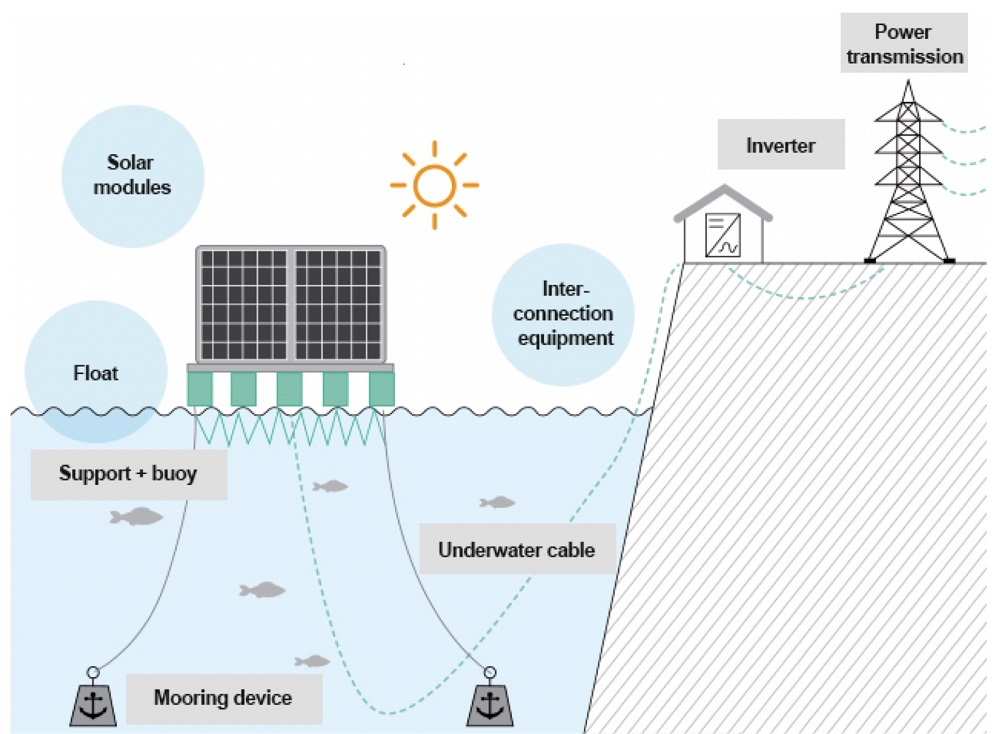
It is an eco-friendly method of generating electric power that combines marine technology and renewable energy technology. Solar modules are made to float on the surface of water, such as a dam or a reservoir. Electricity is sent through underwater cables to a transmission tower.

Figure 1: Floating PV Generation Concept

Source: K-Water

What are the benefits of a floating PV system?

  • Promotes land-use efficiency. As the floating PV energy systems are set up on water, the land can be used for other purposes. It requires no construction on land or conversion of forest and farmlands for solar power facilities.
  • Provides high-energy yield. The increased energy generation is due to the natural cooling effect of the water, which reduces rises in temperature of the solar modules.
  • Saves water resources. It reduces the evaporation of water in the reservoir since the floating PV system blocks the sunlight.
  • Uses an eco-friendly system. Natural fish farms thrive under the platform.

Four environmental impact analyses by the Korea Environmental Policy and Evaluation Institute (KEI) from 2011 to 2019, showed that the floating PV facilities caused no harm to the environment, developed a ground for fish spawning, increased aquatic plants, and reduced algae. Also, as of 2018, the floating solar farms in the country has reduced the amount of carbon emissions by 52,414 tons.

What are its features?

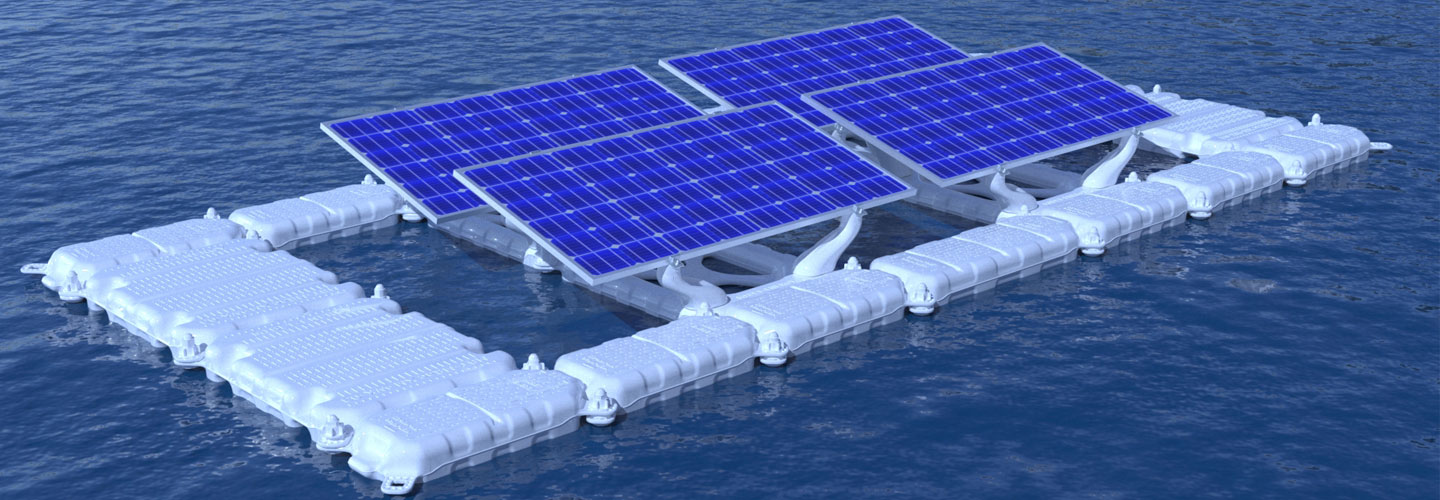
A floating solar power plant is composed of the solar module, buoyancy body, and anti-rust material, which includes the vertical frame and horizontal frames, inspection footrest, and module mount assembly.

The solar module should be highly resistant to humidity, lead-free, dust-proof, and protected against the effects of temporary jets of water, and it should have passed the drinking water test. Floating PV Mounting System is applied to solar pv power plant installation on the water. Adopting HDPE material, it should pass the Hunt Water Absorption Test, Anti-Aging Test, Anti-UV Test etc. Moreover, it can bear the pulling force that is much higher than other products. Adopting new module design in floater and main floater, it can realize the array of double row in the same facing or in symmetrical facing, which can increase the efficiency of solar power generation and installation capacity, be easily installed, and save the cost. and its lifetime has more than 25 years.

Figure 2: Floating PV Plant Components

SunEvo Solar Floating System

Introduction of IEC Standard Testing for Photovoltaic Solar Panels

Solar panel testing and certifications

Like other types of electronics, solar panel modules go through rigorous testing before installation. These tests are critical to determining the quality and performance of panels under particular environmental stresses, as well as confirming they meet mandated safety requirements. In this article, we’ll review the most common testing and certifications for solar panels on the market today.

Why is solar panel testing important?

Solar panel testing is key to assuring both the quality and safety of a module. Photovoltaic Solar Panels have a long lifespan: properly built and installed equipment should generate usable electricity for more than 25 years. Given the longevity of your investment, you want to make sure that any equipment on your roof will perform well and operate safely on your roof.

With solar becoming more and more popular each day, many states, local governments, and utility companies have come out with new mandates that require any grid-tied solar equipment to hold specific certifications. The same holds true for some solar incentive programs; if you’re participating in a state-funded incentive program, don’t be surprised if they have certain testing or certification requirements for your chosen equipment.

Common solar panel testing & certification standards

While reviewing a solar panel spec sheet, you’ll likely notice a bunch of acronyms and random numbers listed under safety and rating certifications – what do these mean? Below are some of the most common solar panel testing standards and certifications to look for when comparing solar panels:

IEC: International Electrotechnical Commission
The IEC is a nonprofit that establishes international assessment standards for a bunch of electronic devices, including photovoltaic (PV) panels. Importantly, the IEC does not test or certify panels themselves – they establish the standards for other testing facilities to adhere to when evaluating solar panel quality.

IEC 61215: Standards for crystalline silicon terrestrial PV modules
IEC 61215 is one of the core testing standards for residential solar panels. If a solar panel module successfully meets IEC 61215 standards, that means it completed a number of stress tests and performed well in regards to quality, performance, and safety.

IEC 61215 standards apply to both monocrystalline and polycrystalline PV modules, which are the most common types of solar panels. The IEC sets different testing standards for other types of solar electric technologies, such as thin-film solar products (IEC 61646).

Solar panels that meet IEC 61215 standards are tested on the following (and more!):

Electrical characteristics (wet leakage current, insulation resistance)
Mechanical load test (wind and snow)
Climate tests (hot spots, UV exposure, humidity-freeze, damp heat, hail impact, outdoor exposure)
IEC 61215 tests also help determine a panel’s performance metrics at standard test conditions (STC), including temperature coefficient, open-circuit voltage, and maximum power output.

What are Standard Test Conditions (STC)?
When solar panels undergo performance testing, they do so at fixed laboratory conditions, known as Standard Test Conditions (STC). Because these conditions are the same across the industry, one panel’s performance metrics (such as power rating, module efficiency, optimal voltage, etc.) can be compared apples-to-apples against other available options.

IEC 61730: Standard for PV module safety
As with any electronic device, solar panels carry the risk of electrical shock if improperly built. That’s where IEC 61730 comes in: this standard address the safety aspects of a solar panel, encompassing both an assessment of the module’s construction and the testing requirements to evaluate electrical, mechanical, thermal, and fire safety. PV modules that successfully pass IEC 61730 tests run a low risk for these types of hazards.

IEC 62716: Ammonia corrosion testing of photovoltaic (PV) modules ammonia corrosion
Do you live on or close by to a farm? If so, keep an eye out for IEC 62716 – this is a test to determine a module’s resistance to ammonia. While most people don’t have to worry about their high concentrations of ammonia exposure with their PV modules, it can be a concern if you install your solar panel system close to farms and livestock. Ammonia corrosion can accelerate degradation in a panel, leading to lower overall electricity production over the lifetime of your system.

IEC 61701: Salt mist corrosion testing
If you’re lucky enough to be installing solar panels on a beach house, it’s worth checking to see your prospective solar panels have successfully passed IEC 61701 tests. With these tests, panels undergo a series of salt sprays in a controlled environment. After the sprays, testers inspect the modules for physical damage – such as corrosion or delamination– and assess their electrical output and overall performance. Panels that successfully pass IEC 61701 tests are definitely a suitable choice for beach-front solar panel systems or systems that will be in close proximity to roads experiencing high levels of salting in the winter.

IEC 60068-2-68: Blowing sand resistance testing
Some solar panels go through IEC 60068-2-68 testing to determine how well they hold up in sandy desert environments. Frequent exposure to abrasive sand can wear a panel down, leading to physical or mechanical defects over time. If you’re installing solar in an area that sees frequent sand or dust storms, try choosing a panel that successfully passed these tests to maximize the durability of your system.

UL: Underwriters Laboratories
Outside of IEC, the other most common acronym you’ll see on a spec sheet related to solar panel testing is UL. This stands for Underwriters Laboratories (UL), a global safety certification company based in the United States. They provide testing services and certifications for many different types of products, including electric appliances, industrial equipment, plastic materials, and more.

UL 1703: Standard for flat-plate PV modules and panels
UL 1703 is an industry-standard attesting to both the safety and performance of solar panel modules. Similarly to IEC 61215 or 61703 tests, panels with this certification go through simulated climatic and aging tests and have been deemed as safe in regards to mechanical loads, fire, and electrical hazards.

You may find that a solar panel spec sheet lists both UL 1703 and IEC 61730 under safety certifications; this is pretty typical for any solar panel sold worldwide. UL 1703 is a mandate for solar panels sold and installed in North America. IEC 61730, on the other hand, is internationally recognized for safety standards and is more widely applicable to the global solar market.

UL 61730: Photovoltaic module safety qualification
UL 61730, a more recent addition to solar panel testing and certifications, combines the testing procedures and standards of UL 1703 with IEC 61730, allowing for complete international approval in regards to a panel module’s safety and performance.

It will become more and more common to see this certification over time–as opposed to both UL and IEC–because it is often the more cost-effective option for manufacturers. In order to complete solar panel testing, manufacturers need to provide multiple solar panel samples. For companies that plan to sell in both North America and international markets, solely completing UL 61730 testing reduces the number of panel samples needed, allowing for reductions in testing time and costs.

New Record! HJT Solar Cell Efficiency reach 25.23%!


The 166mm monocrystalline HJT solar cell developed by SunEvo has achieved a record-breaking conversion efficiency of 25.23% from the recent testing of the authoritative testing institution ISFH, which means SunEvo’s sturdy improvement in HJT solar cell technology, and indicates the company’s unswerving determination and strength in achieving the particular efficiency.

It is understood that SunEvo had achieved a conversion efficiency of 25.06% for the mass production line of 166 HJT solar PV cell on June 8th, before achieving a new world record of 25.23% by adopting the microcrystalline production process when working with leading HJT equipment supplier Maxwell. According to Doctor Wang, the CTO of SunEvo, the record is a new height achieved on microcrystalline craftsmanship that is possible for mass production, as well as a reliable guarantee in attaining a mass production efficiency of 25.5%.

Senior insiders of the industry commented that the regular-sized 166mm Champion cell announced by SunEvo still uses the sputtering TCO film for the PVD mass production process, which offers feasibility in extensive mass production, while the difficulty and gold content are self-evident. The company has been aggressively exploring methods in elevating efficiency and reducing cost, and achieved constant improvement in mere months, as well as multiple critical breakthroughs in N type high-efficiency mono-Si HJT solar cell technology.

Doctor Wang commented that HJT solar cells can be further improved in efficiency by replacing the current doped amorphous silicon with doped microcrystalline silicon or doped microcrystalline silicon oxide (carbide), where both the doping concentration and light transmittance would elevate, and the electrical resistance of the doped layer would reduce, before the current density of the HJT cell is magnified at the end. Doctor Wang said that the company anticipates a constantly improving record of efficiency, and these high-efficiency technologies will be applied on the production lines to achieve extensive production under low cost and applications for GW-grade 25%+ HJT cells.

HJT still possesses a relatively large sum of impedances and difficulties in progression after 30 years of development since 1990; thus, a reinforcement in the guidance and innovation of leading companies are exceedingly important in the expedition of commercial applications of HJT, as well as the actuation of technical upgrades in the relevant equipment and materials of the supply chain. On the occasion of HJT’s 30th anniversary, the Shanghai Solar Energy Society and the TestPV Forum will once again convene the “6th International Forum for the Leading Mass Production and Supply Chain Coordination of HJT”, which centralizes global businesses and experts from the research, manufacturing, application, and investment fields of solar cells, as well as comprehensively probes into the technology and popular market topics of each segment of the HJT industry chain, and penetrates into the future development orientation of HJT cells.